FieldMind
Useful intelligence.
No signal required.
Offline-first memory for field technicians: record what happened, find it later, and share only what should leave the device.
- ~1 ms on-device search
- Qdrant Edge hackathon
- Team Compilers
The challenge
Field work doesn’t stop when the connection disappears. A technician needs to record notes, search previous work, and get grounded answers on the device—without quietly sending private details into the fleet’s shared memory.
Local by design
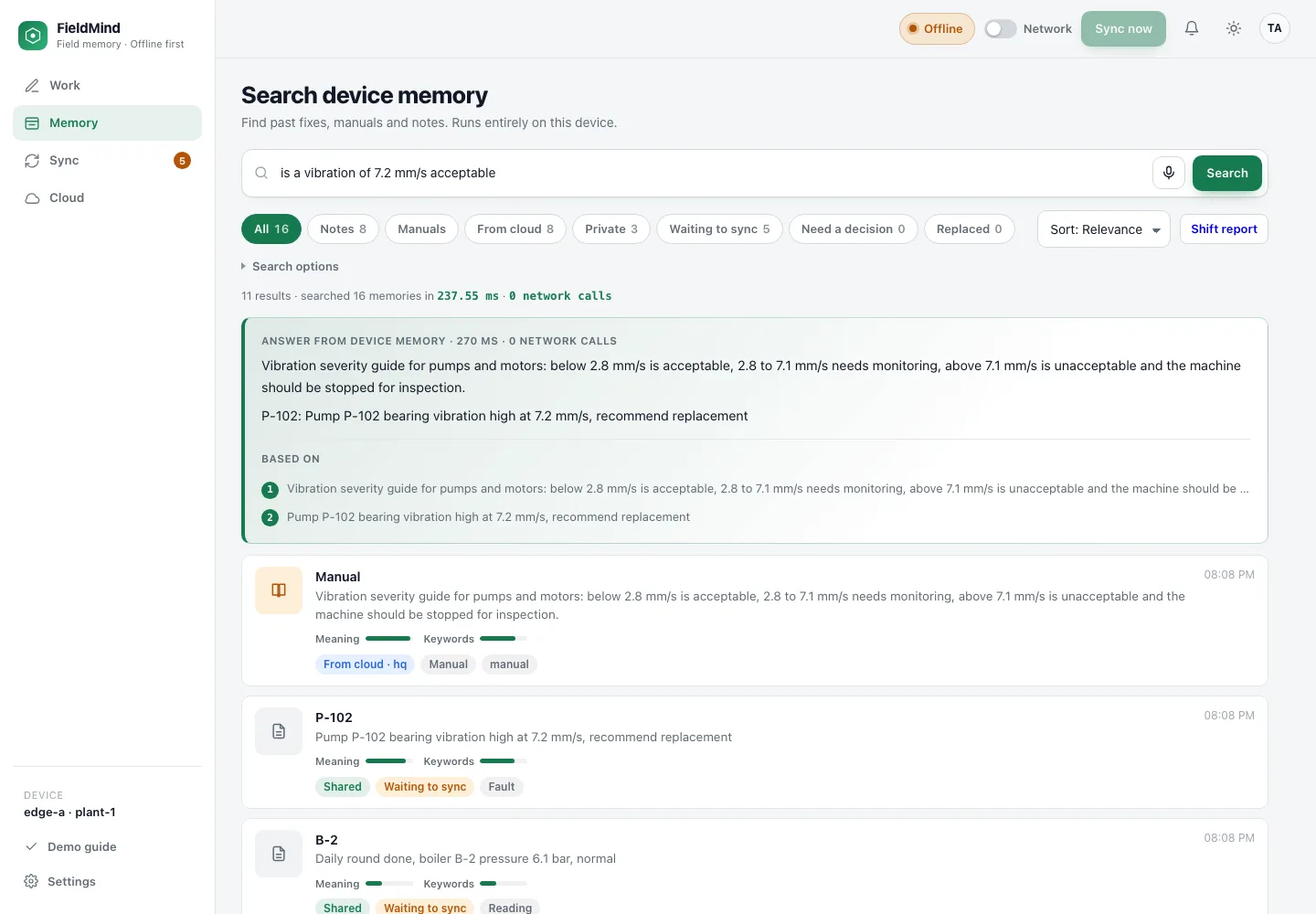
Qdrant Edge shards run inside the application process. Dense vectors and BM25 support local retrieval. A small language model phrases answers from retrieved notes with citations; numbers, asset tags, and verdicts are checked against their source. If they don’t match, the device quotes the notes instead.
Sharing with boundaries
A policy engine combines pattern detectors, a quantised BERT model, and semantic classification to decide whether a note stays private, can be shared, or needs masking. Changes enter a durable outbox before sync. Concurrent edits merge field by field, while genuine conflicts wait for a person.
What I’d do differently
Start with the conflict model, not search. Deciding what happens when two devices edit the same note offline shaped the entire system. Fast retrieval was only one piece of a trustworthy offline experience.
Care about what people see.
Care just as much about what they don’t.